

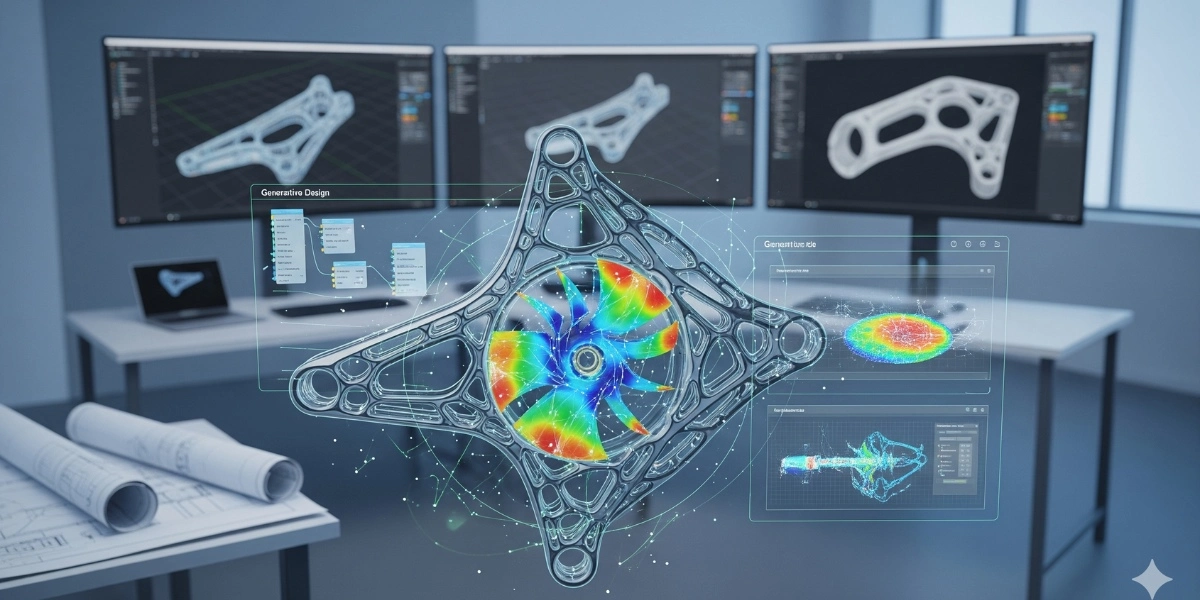

Mechanical engineering is entering a new era where human creativity meets artificial intelligence. Traditional design methods, while effective, often limit innovation because engineers rely on past experiences and established practices. Generative design CAD is changing this by using algorithms, machine learning, and simulation data to automatically produce hundreds of design options that meet set requirements. The result is lighter, stronger, and more efficient structures that would be nearly impossible for humans to create alone.
In this blog, we’ll explore what generative design is, how it works, the role of AI in mechanical design, its applications, advantages, challenges, and why it is shaping the future of engineering. We’ll also look at some leading generative engineering software and conclude with how CADify Studio can help you implement this innovation.
What is Generative Design?
Generative design is an iterative design process that uses mathematical optimization and finite element analysis (FEA) to create optimized part geometries. Engineers input constraints such as loads, materials, manufacturing methods, and fixed geometries. The software then generates hundreds of possible solutions that balance weight, strength, and performance.
Unlike traditional methods, AI in mechanical design enables the system to evaluate each option against defined goals. It refines future iterations, creating organic and intricate structures that maximize efficiency. These designs are not simply AI inventions; they are guided by human objectives and engineering principles.
For example, to design a drone frame or a seat bracket, engineers provide dimensions, load conditions, and performance requirements. The generative engineering software then delivers multiple alternatives—often reducing material use, consolidating parts, and improving performance.
How Generative Design Works
The process of generative design CAD typically follows six steps:
- Problem Definition: Define the design goals, requirements, and constraints.
- Data Collection and Entry: Input material choices, load conditions, manufacturing limits, and evaluation parameters.
- Model Generation: The software produces multiple design iterations.
- Model Evaluation: Designs are ranked and filtered based on performance metrics like weight, cost, or strength. Designs are ranked and filtered based on performance metrics like weight, cost, or strength.
- Model Evolution: The system refines the best solutions for improved accuracy.
- Model Selection and Refinement: Engineers choose the top options and make manual adjustments before final approval.
Generative Design Software in Mechanical Engineering
Several generative engineering software tools are leading the way. Let’s look at some popular ones:
Autodesk Fusion 360
Fusion 360 integrates cloud-based algorithms with AI and machine learning. It automatically generates and ranks solutions, grouping geometrically similar designs. General Motors famously used it to redesign a seat bracket, resulting in a component that was 40% lighter, 20% stronger, and consolidated multiple parts into one.
Key Features:
- Multi-objective optimization
- AI-driven clustering of alternatives
- Manufacturing-aware functionality (CNC machining, additive manufacturing, casting)
nTopology
nTopology emphasizes field-driven design and implicit modeling. It uses simulation data, such as stress fields or thermal distributions, to directly shape geometry. For instance, Cobra Aero redesigned a drone engine cylinder with internal lattice structures for better cooling and reduced weight.
Key Features:
- Lattice generation
- Multi-physics optimization
- Reusable templates for automation
Siemens NX
Siemens NX integrates generative design CAD with existing workflows. It uses topology optimization and convergent modeling, making outputs directly editable as CAD solids. Siemens redesigned a robotic gripper from 30 machined parts into 5 additively manufactured components, achieving a 90% weight reduction.
Key Features:
- Manufacturing-aware optimization
- GPU-accelerated performance
- Convergent modeling technology
PTC Creo
Creo’s generative design feature is fully integrated, eliminating disconnected processes. It leverages cloud computing to explore hundreds of material and manufacturing scenarios simultaneously, making it highly efficient for engineers.
Suitable Manufacturing Methods
One challenge with AI in mechanical design is producing the complex geometries created. The main methods are:
- Additive Manufacturing (3D Printing): Builds parts layer by layer, allowing intricate, lightweight structures. Common in aerospace and automotive industries.
- Casting: Produces complex shapes as a single part, sometimes requiring post-processing.
- Injection Moulding: Suitable for mass production of plastic parts with consistent quality.
- CNC Machining: Highly accurate, especially with 5-axis machining, suitable for precise tolerances.
Advantages of Generative Design
- Time Savings: Reduces project timelines by at least 20%, speeding up time-to-market.
- Creative Options: Generates designs that break away from human biases.
- Parts Consolidation: Replaces multiple components with a single optimized part.
- Lightweighting: Essential in aerospace and automotive for reducing fuel costs.
- Reduced Waste: Optimizes material use and lowers production costs.
- Improved Performance: Eliminates weak areas and increases structural strength.
Challenges and Limitations
While powerful, generative engineering software has its drawbacks:
- Manufacturing Complexity: Some designs are difficult to produce without advanced methods.
- High Computational Demands: Requires cloud or GPU-based systems.
- Expertise Required: Engineers need skills in AI, FEA, and simulation tools.
- High Costs: Licensing and subscription fees can limit access for smaller firms.
- Too Many Options: The abundance of designs can overwhelm decision-making.
- Early Technology Stage: Algorithms are still evolving and improving.
Why Generative Design is the Future
The future of AI in mechanical design looks bright. As algorithms improve and manufacturing methods like 3D printing become more accessible, generative design CAD will become mainstream. Already, industries like aerospace, automotive, and robotics are seeing huge benefits:
- Airbus reduced the weight of a partition bracket by 45%, saving massive amounts of fuel.
- Robotic grippers and drone frames are becoming lighter and more efficient.
- Automotive parts are designed to be both durable and lightweight, cutting costs and emissions.
In short, generative design is not replacing engineers—it is empowering them. By combining human creativity with AI-driven tools, mechanical engineers can achieve breakthroughs faster than ever before.
Conclusion
Generative design CAD is set to transform mechanical engineering by creating innovative, lightweight, and efficient structures. With the help of AI in mechanical design and powerful generative engineering software, industries are already reaping the benefits of cost savings, performance improvements, and faster innovation.
If you’re looking to implement generative design in your projects, CADify Studio can help in this. Our team specializes in modern CAD solutions tailored to mechanical engineering challenges.